From Rural Roots to Traditional Pharmacy: An interview with Vietnamese traditional medicine pharmacist Dr. Nguyễn Thành Triết
Long before accepting his role within the Faculty of Traditional Medicine at the University of Medicine and Pharmacy (UMP), Dr. Nguyễn Thành Triết spent his youth in Vietnam's countryside, where he was fascinated by the native flora and fauna. Transferring his love for nature to his career today, Dr. Triết is now the Head of the Department of Traditional Pharmacy at UMP and a main lecturer of traditional medicine, where he helps aspiring traditional medicine pharmacists grow into future leaders of the field.
A passion for traditional medicine rooted in nature
Growing up in Vietnam’s countryside, Dr. Triết remembers being “very interested in the plants, the animals, [and] everything belonging to the nature.” Surrounded by the rich biodiversity of Vietnam, Dr. Triết’s path to traditional medicine took several turns. As a child, he strove to be an animal research scientist, inspired by the native wildlife he encountered around his home. However, upon entering high school, Dr. Triết took a liking to Chemistry and Biology. Observing that pharmacy would combine these subjects, he entered the University of Medicine and Pharmacy of Ho Chi Minh City (UMP) on track to receive a master's degree in pharmacy, where he discovered the subject of Vietnamese medicinal plants. The field stood out for its two values: protecting the native wildlife and recognizing the rich biodiversity of Vietnam. He detailed, “In traditional medicines… we have some love for protecting animals—that is the reason, for the materials in traditional medicine, mostly we use medicinal plants [rather] than animals. And the medicinal plants [are] very trusting because Vietnam’s ecosystem is very diverse.”
Vietnamese medicinal plants, through the eyes of a traditional medicine pharmacist
To better understand his draw towards traditional medicine, Dr. Triết began by describing Vietnamese medicinal plants to a foreign audience, tracing their roots in the rich biodiversity of Vietnam. Medicinal plants are a subset of the field of Vietnamese traditional medicine. As one of the most biodiverse countries in the world, Vietnam has incorporated the use of traditional medicine into daily life and healthcare practice—a cultural trend that is also present in “other developing countries, [where] around 80% of the population uses traditional medicine as the primary healthcare system.”
Dr. Triết distinguished Vietnamese traditional medicine (VTM) from traditional Chinese medicine (TCM). In the past, Vietnamese traditional medicine was divided into two branches: Northern medicine and Southern medicine. Northern medicine (Thuốc Bắc) is derived from TCM. Northern medicine was often associated with the rich, as importing tonic medicinal plants was costly and required a complex preparation process. In contrast, Southern medicine (Thuốc Nam) was uniquely Vietnamese. Southern medicinal plants grew in abundance in native soil and were simple to prepare. Dr. Triết explained, “sometimes we just dry it [(medicinal plants)], we can cut it to small pieces, and then we can cook with boiling water, and we call this method the decoction.” All social classes could easily access Southern medicine, with temple systems such as Hưng Minh Tự having provided free traditional medicine clinics to local Vietnamese in need for over 100 years.
Today, Vietnamese traditional medicine no longer distinguishes between the two “branches” of its past. Instead, it blends together old and new, advancing beyond its early ties to traditional Chinese medicine. This evolution, Dr. Triết emphasized, has characterized its uniqueness among other fields.
Expanding Vietnamese traditional medicine literature through research
Having grounded himself in the history of traditional medicinal plants, Dr. Triết chose to further specialize in research. After completing his Master’s in Pharmacy at UMP, he began a PhD program in Austria, working under Professor Dr. Rudolf Bauer. Explaining his reasoning for pursuing graduate studies abroad, Dr. Triết revealed that universities in Vietnam often have less research equipment than their international counterparts. Thus, packing his suitcase with plant materials, Dr. Triết brought Vietnamese native medicinal plants to Austria with a mission—to find evidence of their efficacy, improve their value, and increase their usage worldwide.
Fast forward to the present, Dr. Triết is now a lead researcher who continues his mission in Vietnam, studying the pharmacology (how drugs affect living organisms), ethnopharmacology (an interdisciplinary study of plants used for medicinal purposes), and phytochemistry (a branch of chemistry related to plants) of medicinal plants. His research investigates the bioactivity from medicinal plants of the Zingiberaceae (ginger) and Theaceae (Tea) families. By focusing on Vietnamese medicinal plants within these families, Dr. Triết aims to translate this research into information that physicians can use to understand how to integrate common traditional and folk remedies into modern practice.
Dr. Triết does this in three directions. The first is mentorship. As a professor, he lectures both modern and traditional pharmacy students, teaching them the isolation of chemical structures in Vietnamese medicinal plants. His lab also accepts students from a diverse range of fields, welcoming aspiring pharmacists, scientists, and medical doctors to learn the fundamentals of Vietnamese medicinal herbs. For example, he noted, “I have one PhD student working on investigat[ing] the phytochemical and bioactivity for [the] zingiberaceae [(ginger)] family, and some [of] my Master’s student [is] working for some Vietnamese medicines.” Dr. Triết’s research also extends to Vietnam’s native yellow camellias of the Theaceae (Tea) family. What makes the yellow camellia special is its extremely low caffeine content, compared to other teas. He highlighted, “Yellow Camillias, they have a lot of polyphenols inside, so the antioxidant activity is very strong, but they have very less content of caffeine - and some species we could not find the caffeine inside.” Thus, further researching yellow camellias would allow physicians to incorporate a natural antioxidant into patient treatments without the adverse effects of caffeine.
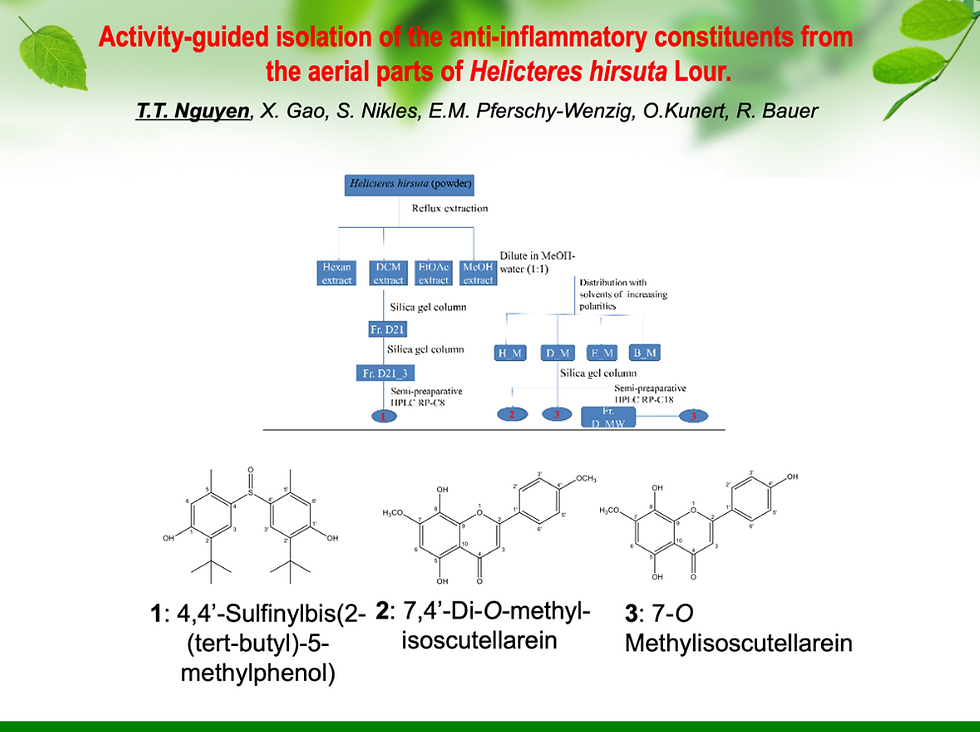
His second direction is the quality control of medicinal plants. Dr. Triết studies their anatomical differences and verifies his findings through DNA analysis. Given that plants contain multiple markers for bioactivity, establishing a method for anatomical identification provides an extra layer of standardization.

Dr. Triết’s final direction is to relate medicinal plants and the modern pharmacological activity of their remedies, specifically focusing on activities in the gut microbiome. Dr. Triết explained, “The gut microbiome plays [a] very important role, especially in the bioactivity or to metabolize the phytochemicals inside the medicinal plants.” This can result in two outcomes: the gut bacteria transforming the compounds into different substances or the compounds altering the biodiversity of gut bacteria. These changes are essential to understand because changes to the gut microbiome can influence the intended effect of the medicinal plant. He revealed, “In Europe, now they have a lot of professionals to investigate the interaction between gut microbiome and medicinal plants in the connection to your long life,” further emphasizing the international relevance of this research today.

Yet, beyond its potential, Dr. Triết also noted that Vietnamese medicinal plants face challenges in modern healthcare today. He emphasized that, for traditional medicine, on “One side we have to follow the traditional use and another side we have to prove the modern activity.” This has proven difficult, as various countries have different theories on the use of a particular medicinal plant. Thus, in addition to evidencing the modern activity of a plant for international standardization, it is also crucial to respect the thousands of years of history that have directed its use.
A reflection on Vietnamese medicinal plants in 21st-century Vietnam
Today, medicinal plants are woven into daily life across Vietnam, like cuisine. In the popular Vietnamese coffee, Dr. Triết detailed, “some company they mix the lotus leaves…it [has] a very good sedative activity,” which can combat the caffeine. Furthermore, local Vietnamese often add banana flowers to salads and wrap sticky rice with lotus flowers. Traditional medicine is also institutionalized in Vietnamese healthcare, with most modern facilities dedicating at least one department to the practice.
Yet, most importantly, Dr. Triết urges readers to understand Vietnamese traditional medicine through a historical and scientific perspective. Its history differentiates it from neighboring traditions. For example, while traditional Chinese medicine is based on yin and yang, Vietnamese traditional medicine focuses on water and fire, as established by Hải Thượng Lãn Ông, a credited founder of the field. At the same time, Dr. Triết stresses that the future of medicinal plants relies on research to increase their use and value worldwide.
Looking ahead, Dr. Triết strives for a more integrated world between traditional and modern medicine, underscoring the opportunity for medicinal plants to be institutionalized in hospitals worldwide. Their potential is vast, he emphasizes, but to get there, we must first understand and research.


Comments