A Brief Visit to the Department of Traditional Medicine at An Bình Hospital
Located in the An Bình province of Ho Chi Minh City, Vietnam, the An Bình Hospital serves nearly 60,000 residents and the surrounding areas. Entering the hospital on a Tuesday early morning, the lobby was bustling with patients and visitors. Although the hospital is still in the process of transferring departments into its new, expanded facility, it has continued serving patients at full capacity.
To check into their appointments, patients followed a ticket queue management system operated by an electronic kiosk. On the kiosk, I observed 24 different hospital specialties, ranging from synthetic surgery to language therapy. To my surprise, the kiosk labeled the traditional medicine department as “Y học cổ truyền - Vậy lý trị liệu,” or Traditional Medicine - Physical Therapy. Since physical therapy was already listed as a separate department on the kiosk, this overlap stood out. However, I would later learn this listing was intentional, exhibiting the integrated nature of the practice with modern medicine.

The Traditional Medicine Department
The department was composed of three services: acupuncture, pharmacy, and herbal medicine. Outside the pharmacy, a diverse range of 30-40 patients sat awaiting medications or treatment. Due to privacy reasons, I did not take pictures of the pharmacy; however, it resembled a typical, outpatient hospital pharmacy, with rows of medicine lining its interior.
Directed past the pharmacy, I entered the acupuncture room, or Phòng Châm Cứu. Here, I met Dr. Lê Thị Tường Vân MD, MS, the Head of the Department of Traditional Medicine at An Bình. Around eight patients were stationed at hospital beds for treatment, which Dr. Vân explained was electroacupuncture. In this method, acupuncture needles are clamped by electric probes that transmit different frequencies through a machine. The labels on the machine were written in both English and Chinese, indicating an international application for its use.

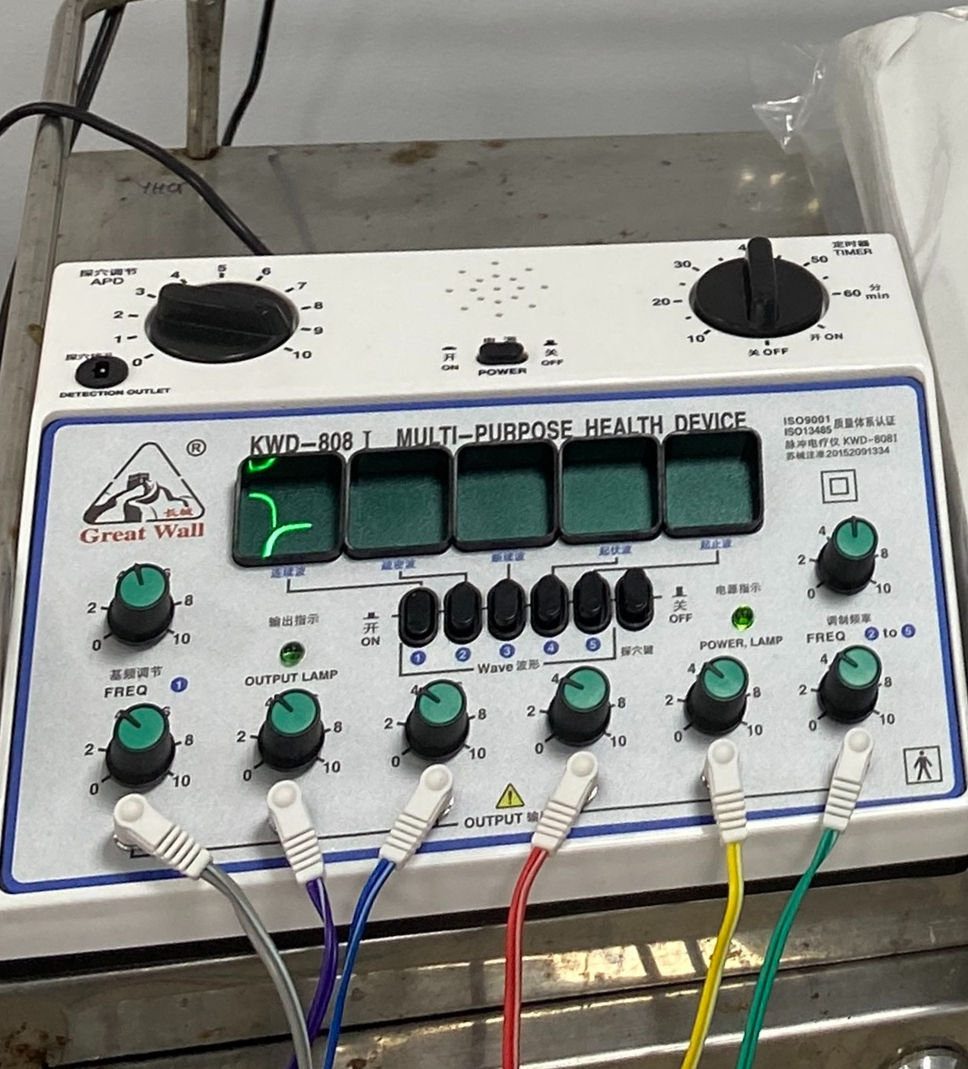
Some patients also received treatment with an infrared light shining above the area of electroacupuncture. Dr. Vân explained that, analogous to a heat lamp, the infrared light worked to reduce tension in the affected area by increasing circulation, producing effects similar to moxibustion - a herbal medicine practice where dried mugwort is burned to prepare an area for acupuncture.
According to Dr. Vân, the typical treatment plan for acupuncture patients lasts 15 days. However, patients receive their treatment in shorter sessions, such as three sessions, comprised of five days per week. For patients seeking an alternative to electroacupuncture, Dr. Vân also explained that the department offers embedded catgut, which also has a treatment that lasts 15 days. However, although it can have longer-lasting effects, the treatment is considered more intense than electroacupuncture.
Herbal Medicine
Exiting the acupuncture room, Dr. Vân then guided me to two rooms in the corridor, designated the “herbal medicine storage,” where herbal medicines are to be stored, and “herbal decoction,” where herbal medicines are to be prepared.

At the time of my visit, the rooms were empty due to a recent policy change that has temporarily halted the importation of raw herbal medicine into An Bình Hospital. Yet, the department pharmacy continues to offer thuốc thành phẩm, or finished medicine, based on traditional medicine philosophies.
An integrated healthcare system
Lastly, to conclude our conversation, I asked Dr. Vân about how the traditional medicine department has integrated with other modern medicine departments in the hospital. She stated, “It is especially integrated with the Neurology Department.” For example, if a patient were to suffer a stroke, the neurology department can invite traditional medicine doctors to diagnose and give complementary treatment. Patients often undergo physical therapy first, followed by acupuncture for pain. This integrated approach explains the combination of “traditional medicine - physical therapy” seen earlier on the kiosk.
My visit in summary
Ultimately, my visit to An Bình Hospital emphasized how the Vietnamese healthcare system integrates traditional medicine with modern medicine practice. By curating patient care to their needs and cultural values, this hospital provides a model where the holistic care of patients is prioritized - an approach that international hospitals may one day consider adopting.


Comments